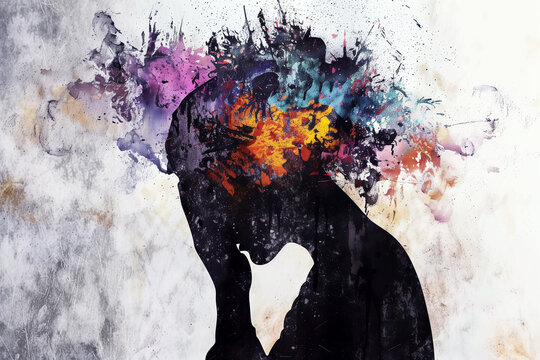
I’ve been thinking a lot about whether there’s a hierarchy of hurt—an unspoken ranking of whose pain is taken seriously and whose is dismissed. My own story keeps pulling me back to this question.
I was diagnosed with bipolar affective disorder when I was 18. My life at the time was collapsing around me: my parents’ relationship had fallen apart, and my mother had attempted suicide. Everything felt chaotic, frightening, and unbearably heavy. Looking back, it’s hard not to see my symptoms as a response to that emotional earthquake. But the diagnosis came wrapped in the language of biology, as if my distress lived only in my brain and not in my life. Since then, I’ve been on a significant dose of antipsychotic medication—treatment for the biology, not the biography.
The Diagnostic Divide: Biography vs Biology
What strikes me now is how differently we treat different kinds of suffering. Some forms of pain are allowed to have a story; others are stripped of context.
For me, the hierarchy starts with how we explain where the hurt comes from:
- At the top sits CPTSD, which is framed as a wound inflicted by others. It casts you as a survivor, someone who endured something real and recognisable. It feels validating because it acknowledges the world’s role in shaping your pain.
- In the middle sits bipolar disorder, often described as a chemical imbalance or genetic fate. It’s “nobody’s fault,” which can be comforting, but it also risks turning you into a malfunctioning machine. It ignores the fact that my first episode happened during extreme stress, and that I relapsed badly after my partner died suddenly in 2014.
- At the bottom sits BPD, the diagnosis people whisper about. It’s framed as a flaw in your personality, not a response to trauma. Yet research shows that trauma is woven through the lives of people with BPD more than any other personality disorder. Still, the stigma sticks.
And the truth is, many of the so‑called “symptoms” of BPD overlap with my own experiences of bipolar disorder and CPTSD. The boundaries are far blurrier than the labels suggest.
Autism, Women, and Trauma
Things get even more complicated when I add autism into the mix.
As an autistic woman, I’ve learned that people like me are far more likely to experience interpersonal violence. The research confirms what my life has already taught me: when you carry multiple marginalised identities, the world becomes harsher, less forgiving, more dangerous.
My own history is full of experiences that left deep marks—an emotionally overinvolved and critical mother, being sent away to boarding school at ten, a violent adult relationship, suicide attempts, and the trauma of the mental health system itself. I’ve been homeless, unemployed, and treated as if my diagnosis defined my worth. I was also diagnosed autistic late in life, which reframed so much of what I had internalised as personal failure.
When I look at all of this, I can’t help but ask: Who wouldn’t be traumatised?
2. The Validation Gap: The “Status” of Suffering
There’s a social hierarchy in how people respond to different diagnoses.
CPTSD often earns sympathy because it has a clear villain. BPD, on the other hand, is met with suspicion or distance. The same pain, the same terror, the same emotional intensity—yet one is seen as understandable and the other as a character flaw.
This hierarchy shapes how clinicians treat us, too. Trauma isn’t routinely assessed in people diagnosed with BPD, which means the story behind the symptoms is often erased. The system focuses on the fire, not the spark.
3. The Gendered Lens of Pain
Gender distorts the picture even further.
Women’s pain is often labelled as emotional instability. Men’s pain is often ignored or normalised. Boys are more likely to experience physical punishment, yet less likely to report abuse. Women, meanwhile, are overrepresented in diagnoses like BPD—not because we are more “disordered,” but because our suffering is more visible, more pathologized, more scrutinised.
It creates a world where women are diagnosed and men disappear.
Biology vs Biography
My bipolar diagnosis sits awkwardly in the middle of all this.
- Bipolar is framed as biological.
- CPTSD is framed as environmental.
- BPD is framed as a mix of both.
But my life has never been that neatly divided. My biology and biography are tangled together. My moods don’t exist in a vacuum; they rise and fall with the tides of my life.
Yet the system treats these categories as separate, and so I’ve often felt treated in pieces rather than as a whole person.
4. The Biopsychosocial Bridge
The Biopsychosocial Model offers a way to collapse this hierarchy. It recognises that suffering is shaped by:
- Biology—our temperaments, our sensitivities.
- Psychology—our coping strategies, our internal worlds.
- Social context—our environments, our relationships, our histories.
But even here, language can wound. Vulnerability is often framed as a flaw, as if resilience is something you either have or don’t. My experience tells me resilience is shaped by the world around us. It’s hard to be resilient when the environment is hostile, invalidating, or inaccessible.
Refining the Conclusion
The “Hierarchy of Hurt” isn’t real in the body or the brain. It’s a construct—clinical, cultural, and deeply social. Whether pain comes from trauma or neurobiology, the suffering is real. The hierarchy serves the system, not the person.
My healing hasn’t come from diagnoses or labels. It has come from:
- My environment—green spaces, community, movement, accessibility, connection.
- My experiences—the long arc of my life, the losses and the joys, the discrimination and the resilience, the poverty and the survival.
My story doesn’t fit neatly into any diagnostic box. Most people’s don’t. But maybe that’s the point. Maybe the hierarchy only exists because we keep trying to force human suffering into categories that were never designed to hold it.
 Freeframe Governance